
|
The gut microbiome - how does it work?

By MICROBA
What can we measure?
Advances in research and technology have begun to reveal the important role that the gut microbiome has on human health. The microbiome has been linked to a range of health conditions, from gastrointestinal disorders like IBD and IBS, through to insulin resistance and diabetes, weight management, and even mental health.
It is now possible to assess the gut microbiome and understand its potential to influence health. However, because the gut is such a large organ, the composition of microorganisms can differ depending on their location. Then, what can be measured by a stool sample? And how can it be measured?
Gut environments and their relationship to the microbiome.
Each part of the gut has a very different environment and in each one different communities of microorganisms can grow. For example, bile acids neutralise the stomach acid make small intestine less acidic. In addition, the levels oxygen and antimicrobial compounds in the small intestine are higher than in the large intestine, so fast-growing bacteria tend to predominate. On the other hand, the large intestine has fewer antimicrobial compounds and is anaerobic (no oxygen), and the movement of undigested food, as fibre or excess protein, is slower. This promotes the growth of bacterial populations capable of processing undigested food without the need for oxygen.
The large intestine has the highest density and total number of bacteria in the entire gut1.
Which microbiome is the “gut microbiome”?
When talking about the gut microbiome, people usually mean the microbial community inhabiting the lower end of the large intestine, because the typical material measured is the stool. However, stool mostly consists of microbes that live in the lumen of the large intestine, which is where the undigested food passes through. Studies have shown that the community of microbes living in the lumen are different from those that live in the mucus layer that lines the large intestine. A stool sample wouldn’t give you information about this mucus-living community.
Is a stool sample enough to measure all parts of the intestinal microbiome?
Although it is possible that some bacteria transfer between different parts of the gut, a stool sample will not typically detect the microbiome of the stomach, the small intestine, the first part of the large intestine or the mucus layers. Therefore, stool samples are not suitable to detect conditions in other parts of the gut, such as a stomach infection, or small intestine bacterial overgrowth (SIBO).
The gut microbiome and its effect on well-being and health
Stool microbiomes from the large intestine are the most commonly studied because samples are much easier to obtain than biopsy specimens. Studies have found that the stool microbiome of people with some physical and mental disorders is different from the microbiome of healthy people2-4, suggesting that it may be useful as a measure of general health status.
For example, it’s been observed that healthy people have greater microbial diversity than unhealthy people5-6, although it is not yet known whether the differences in the gut microbiome are a cause or a consequence of the disease.
Specifically, in the stools of unhealthy people with specific conditions, these studies have observed specific bacterial species at higher and lower relative abundances, as well as seeing differences in the potential of the bacteria to produce different metabolites that can influence health.
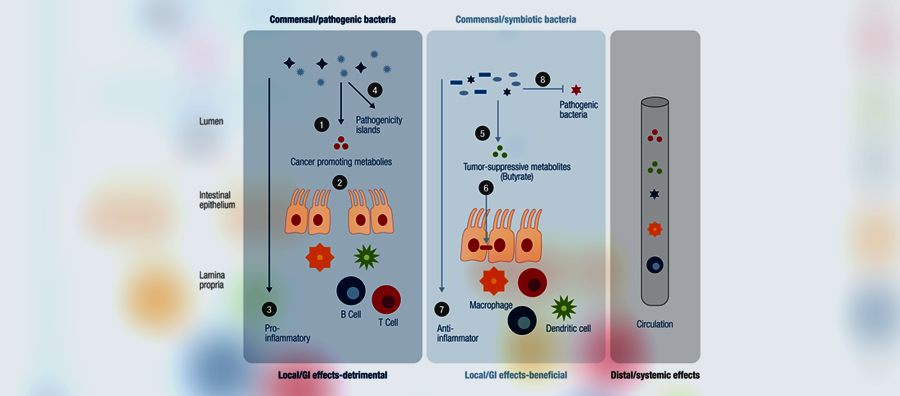
Image inspired by: Bhatt, A. P., Redinbo, M. R., & Bultman, S. J. (2017). The Role of the Microbiome in Cancer Development and Therapy. CA Cancer Journal for Clinicians, 67(4), 326–344.
This exciting research indicates that there are likely to be aspects of a stool sample that could be used for non-invasive screening of some diseases and diagnosing some conditions and even helping customise your treatment options. As our understanding of the microbiome advances along with the technology, gut microbiome screening will become part of a standard of healthcare, and part of your regular health checks during routine visits with your doctor.
References:
Sender, R., Fuchs, S., & Milo, R. (2016). Revised Estimates for the Number of Human and Bacteria Cells in the Body. PLoS Biology, 14(8): e1002533.
Lynch SV, Pedersen O. (2016). The Human Intestinal Microbiome in Health and Disease. N Engl J Med. Dec 15;375(24):2369-2379.
DAS B, Nair GB. Homeostasis and dysbiosis of the gut microbiome in health and disease. J Biosci. 2019 Oct;44(5):117.
Milani C, Duranti S, Bottacini F, et al. The First Microbial Colonizers of the Human Gut: Composition, Activities, and Health Implications of the Infant Gut Microbiota. Microbiol Mol Biol Rev. 2017 Nov 8;81(4).
Rowland I, Gibson G, Heinken A, et al. Gut microbiota functions: metabolism of nutrients and other food components. Eur J Nutr. 2018 Feb;57(1):1-24.
Lloyd-Price J, Abu-Ali G, Huttenhower C. The healthy human microbiome. Genome Med. 2016 Apr 27;8(1):51.